





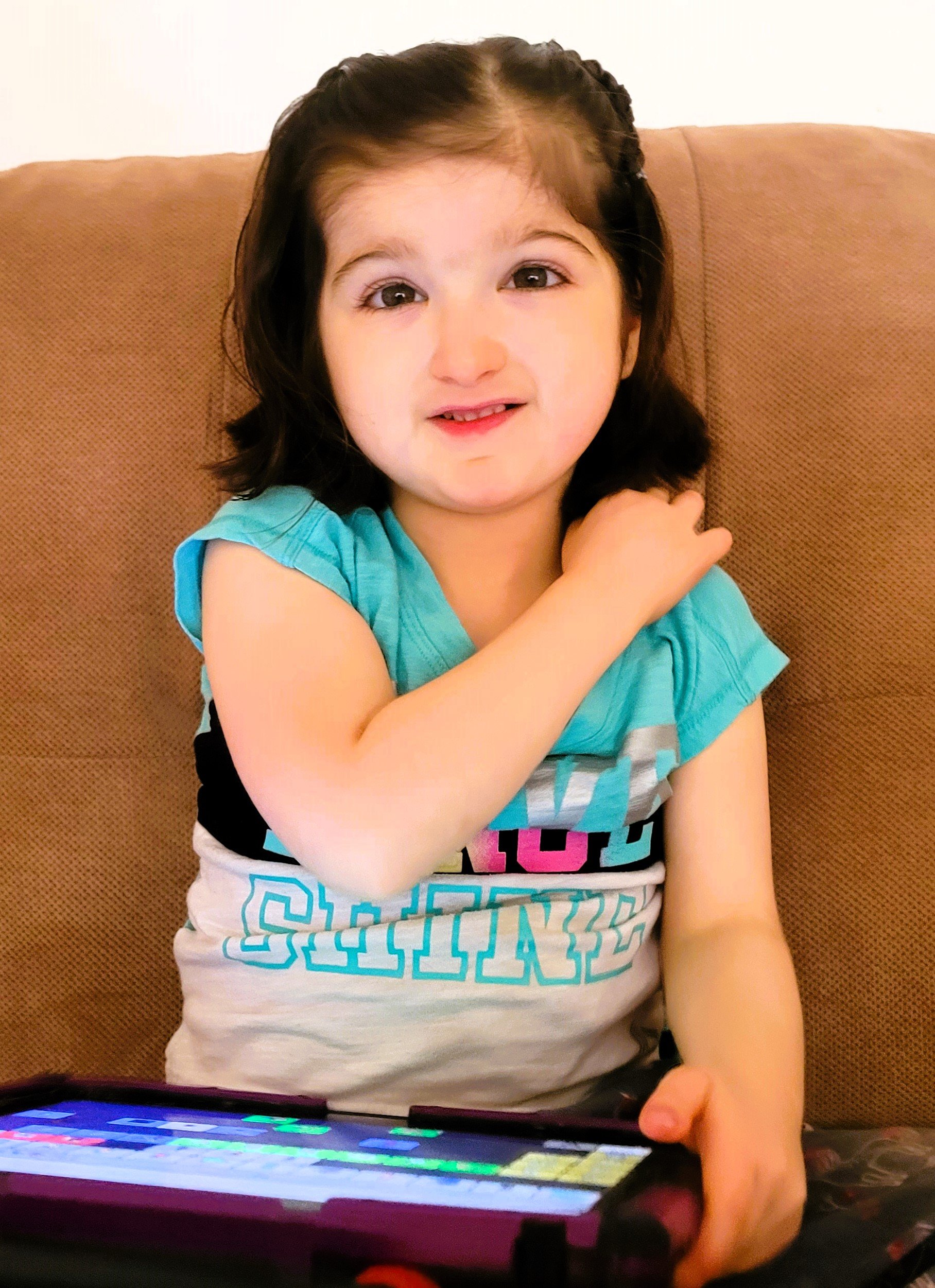
by Whitney Prado, Parent of Paige Prado
Meet my precious Paige, a firecracker four-year-old who is always ready to tell a joke. Paige was diagnosed with a rare condition called Rubinstein-Taybi Syndrome. Kids and adults with this condition are expected to have moderate to severe cognitive disabilities as well as other physical challenges.
Advocate, advocate, advocate…. At two years old, my wonderful daughter was showing signs of comprehension and capability far beyond what was expected. Paige and I had found our own way of talking to each other as mother and daughter, but how would the rest of the world understand? This thought prompted the start of her AAC journey. When she was two years old, Paige was evaluated and set up with the Accent 1000, which we still use today.
Although two years old might seem young to start using a communication device, I wanted to give Paige every opportunity to reach her potential as quickly as possible. Before the device, we used baby sign language with her to communicate. This often led to frustration and a lack of understanding. The Accent 1000 became the game changer we all needed to move her forward into a higher quality of life. The person behind the buttons started to come alive in ways I never anticipated. At the age of 3, Paige started telling preprogrammed jokes, commenting on the world around her, and participating in family fun with her siblings. She began to do more than communicate; she was thriving. She began to reveal her personality, her witty nature, and her exceptional intelligence.
One key thing to note is that, from the moment we started using alternative communication (AAC), our family as a whole committed. Every attempt at communication was honored with a response, no matter how slight or accidental. I intentionally spent every conversation with her modeling. Often it looked like, “You seem frustrated, you don’t like that. You can say ‘no’.” I would then press the talker button or indicate ‘no’ on the board. Very little was forced; I patiently waited and trained.
This feat may seem overwhelming, but what was more overwhelming to me was that children like Paige tend to have extreme behavioral difficulties. The medical world constantly pushes non-verbal kids in therapies, appointments, and medications. Often, their ability to communicate their pain or overwhelm is ignored, and it damages their long-term health. I often wanted to quit at the beginning, especially when all she did was stim on her talker. Paige loved to sing at the time, so we printed a song communication board which she used very regularly, often to my chagrin. The long-term goal of Paige communicating her needs and wants was worth every sacrifice. Over time, the work paid off and became more and more effortless.
One of my favorite interactions several years ago was when her ENT came into the room after a follow-up from surgery and asked her, “Do you remember me?” Paige looked up and pressed, “Oh no!” The doctor and I laughed as it was clear she did remember. Ironically, this interaction brought me so much hope; it brought out Paige’s humanity and gave the doctor a peek into Paige’s world.
On Halloween this year, Paige was able to experience the festivities along with my two other children. As her father and I were discussing plans for the night and how we might keep her separate due to sensory concerns, she asked, “Y?”. She would not stop asking “y” over and over until I agreed she could go along with her siblings. I'm glad she voiced her concerns because, unlike past years, ones of complete overwhelm, this year she greeted people with, “Trick-or-treat”, “thank you”, or “love it”. The best moment of the night was at the end, when her younger brother was told he was no longer allowed to have candy, she retorted “ha ha ha” and everyone laughed.
Paige started with the Unity program using four selections: “go, stop, eat, turn”. She continued to progress in Unity, adding more vocabulary, and we wondered: Could she benefit from an even larger set of words, even though it meant smaller symbols and more of them on a page? Considering her needs and the consistent use of single motor plans, we decided to give LAMP Words for Life a try. As of October this year, she uses LAMP Words for Life full with 84 selections on each page. She has surpassed my wildest expectations, and I am so grateful we set her up when we did. So much effort went into getting her where she is today. My little girl has a non-traditional, but equally important voice.
Editor's note: Thank you, Whitney, for sharing your wonderful article about Paige with our readers.
There are no comments yet. Be the first to post!You must be logged in to post.
Stories and Strategies fo... - early, four