





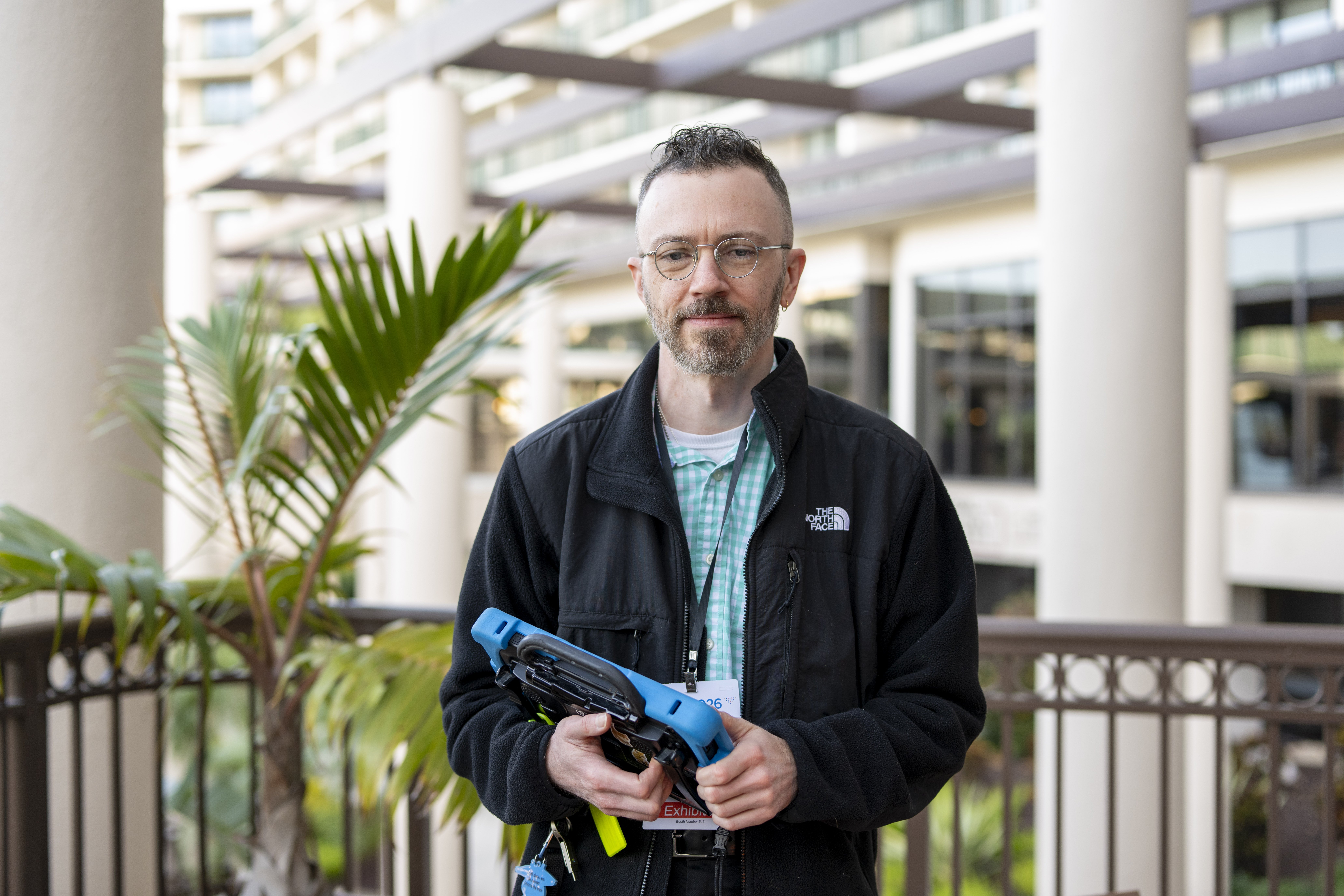
by Lance McLemore, PRC-Saltillo Ambassador
It’s Autism Acceptance month, and I almost forgot about it. I also realized that 2026 is an anniversary of sorts for me. Ten years ago, I received my first PRC-Saltillo device: an Accent 1000 with LAMP Words for Life. I thought it would be nice to reflect on my AAC journey and the past decade in particular.
I received my first AAC device when I was nearing the end of my time in university. I was about 24 years old at the time. In retrospect, university was one of the darkest periods of my life. I don’t think I’ve ever felt so isolated. For most of my university experience I had almost no meaningful or even trivial interactions with anybody. I sat alone in full classrooms and walked alone down busy corridors. I got a front row seat to closely observe all kinds of relationships. Friendships were being made and people were dating. It often felt like I was being tormented, but what could I do to change it? How could I have any kind of relationship if I had no way to communicate? I was profoundly sad and frustrated.
Towards the end of my time in university, I was in the disability office one day. One of the counselors asked to speak to me privately, and she expressed concern that I didn’t have a way to communicate. She recommended that I get an AAC evaluation from United Cerebral Palsy. I went through that process, tried out several different devices, and I ended up getting my first device. I would like to say that it was all smooth sailing after that, but the communication journey is never that easy.
I finally had an AAC device, but something was missing. I should have just been able to start typing and having conversations, but there was a disconnect. Communication is more complex than having a sufficiently large vocabulary. It requires mastery and implementation of multiple skills. In 1989, Janice Light published a definition of communicative competence. One part of communicative competence is social competence. And that was where I struggled the most. I didn’t know how to introduce myself, start a conversation, end a conversation, know how to ask relevant questions, follow up on what was being said, etc. Basically, I didn’t know all those numerous unwritten social rules that almost everyone else knows without thinking. As an AAC user, those rules take on an added layer of complexity. However, at the time I didn’t have the insight that I have now to understand that or explain it to anyone else. Thus, I couldn’t ask for or receive the support I needed.
I continued to struggle for the rest of my time in university. I never really made any friends or any meaningful connections. I remained invisible, socially deprived, and I’m sure I was quickly forgotten. This situation persisted for several years after I graduated. I remained extremely isolated at home. I had no friends, no job, and no purpose. Unfortunately, it’s a situation where many autistic adults find themselves. My hope for my future was rapidly dimming. In early 2016, my AAC device started malfunctioning. Even though my initial experience with AAC was a disaster, I decided to give it another try. I did some research and found PRC. I emailed Sandy the Alabama consultant, and she came to my house to let me try a few devices.
I was impressed with the Accent 1000. She allowed me to keep a loaner while I started the process to get my own Accent. For a few months I preferred using Word Power. Sandy suggested that I join her when she went to university classes and conferences. Without understanding it at the time, I slowly started to improve those social competencies that I struggled with in university. I was finally put in real world situations where I could practice those skills.
In June 2016, I went to a LAMP workshop in my state. John Halloran was the trainer for the workshop, and he explained how and why LAMP worked well. He also spoke about it to me privately. He challenged me to try to learn it. I was willing to try a system that had the potential to make me a faster communicator. The learning curve was steep, but I eventually became comfortable with it. I found that it was much faster and easier to communicate with it.
After that, my world really opened. Most people cannot imagine how many opportunities are lost when you don’t have a way to communicate. I have spoken at numerous conferences, traveled to many places, and met some wonderful people. I have found myself being a member of a small and distinguished club surrounded by many allies, and I take inspiration from them. They encourage me and always make me feel like my thoughts and opinions have value.
If there is some piece of advice I could give, I would say to not forget to support AAC users’ development of social competence. AAC is a powerful tool, but like any other tool, it’s only as useful as you know how to use it. I don’t want any other AAC user to struggle the same way that I did. Communication is like a large complex machine, but it can be easy to hyperfocus on one part. Every part needs attention and support so the whole can function optimally.
There are no comments yet. Be the first to post!You must be logged in to post.
Communicators In Action - Autism Lance