





Building Respectful and Communication-Inclusive Classrooms
As backpacks are packed, classrooms are prepared, and students begin a new school year, AAC teams may be asking:
How can we ensure communication rights are understood, respected, and supported throughout the school day?
Communication is a fundamental human right, regardless of how a person communicates. Every student deserves dignity, meaningful interaction, individualized support, and opportunities to communicate across activities and environments.
For students who use augmentative and alternative communication (AAC), protecting communication rights requires more than simply providing a device. Their AAC tools must remain accessible, their messages must be acknowledged, and they must have meaningful opportunities to communicate for many different purposes.
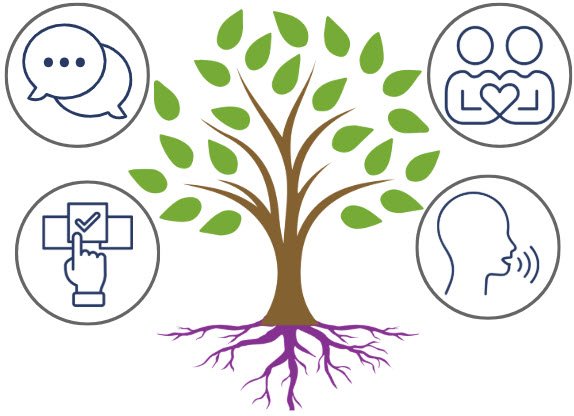
The AAC Language Lab’s Rooted in Communication Rights resource provides a visual reminder of the rights that should be at the heart of every classroom.
Communication Rights Belong Everywhere
Communication rights do not apply only during speech therapy or structured AAC activities. They should be supported during academic instruction, transitions, lunch, recess, extracurricular activities, community outings, and conversations with classmates.
Everyone who interacts with a student shares responsibility for supporting these rights, including:
- Teachers
- Paraprofessionals
- Speech-language pathologists
- Occupational and physical therapists
- Administrators
- Family members
- Classmates
- Other school staff
When communication rights are understood across the entire team, students are more likely to experience consistent access and support throughout the school day.
The Right to Communicate in My Own Way
AAC users may communicate through a combination of methods, including speech-generating devices, communication boards, gestures, facial expressions, body movements, vocalizations, signs, speech, writing, and eye gaze.
There is no single correct way to communicate.
Communication partners should recognize and respond to all meaningful forms of communication. A student should not be required to repeat a message using an AAC system when their original message was already understood.
AAC should expand a student’s communication options—not replace or invalidate the other ways they communicate.
The Right to Use My AAC Tools at Any Time
An AAC system cannot support communication if it is turned off, stored in a backpack, placed on a shelf, or kept out of reach.
At the beginning of the school day, teams can check that the student’s AAC system is:
- Turned on and charged
- Positioned for comfortable access
- Within reach
- Available during transitions
- Transported with the student
- Supported by a backup option when needed
AAC should be available during reading, writing, math, science, lunch, recess, assemblies, and social interactions. Communication can happen at any moment, so the tools needed to communicate should always be accessible.
The Right to Get a Response
Communication is a two-way interaction. When an AAC user communicates, their message deserves a response.
Communication partners can show that a student’s message matters by acknowledging it, responding naturally, and continuing the conversation. This applies whether the message is communicated through AAC, a gesture, a facial expression, a vocalization, or another method.
Communication partners should also allow plenty of wait time. AAC users may need additional time to process what was said, determine what they want to communicate, locate words, and construct a message.
Avoid repeating the question too quickly, adding more instructions, or answering for the student. A quiet pause can provide the time they need to contribute.
The Right to Make Choices That Matter to Me
Students need opportunities to make meaningful choices—not only choices between options selected by adults.
Meaningful choices may include:
- What activity to participate in
- What topic to write about
- Which book to read
- Who to work or spend time with
- How to complete an assignment
- Whether to participate in an optional activity
- What they want to say
- How they want to communicate
Choices should reflect the student’s interests and have a genuine effect on what happens next. When possible, communication partners can move beyond close-ended questions and provide opportunities for students to generate their own ideas through asking open-ended questions.
The Right to Request or Refuse
AAC users have the right to request items, actions, information, assistance, attention, or breaks. They also have the right to refuse.
A refusal is communication. It should not automatically be viewed as noncompliance or inappropriate behavior.
Communication partners can acknowledge a refusal and, when necessary, clarify what the student is communicating. If an activity must still occur, the student may be offered choices about when, where, or how it happens.
Honoring requests and refusals helps students understand that communication is effective and that their messages influence their lives.
The Right to Share My Feelings and Ideas
Communication is about much more than requesting preferred items or answering questions with one correct response.
Throughout the school day, students should have opportunities to:
- Share opinions
- Express emotions
- Make comments
- Ask questions
- Tell stories
- Make jokes
- Discuss interests
- Explain their thinking
- Disagree
- Talk about their experiences
Open-ended questions can support more authentic participation. Instead of asking, “Did you like the story?” try asking, “What did you think about the story?”
The goal is not simply to test the student. It is to create an authentic conversation.
The Right to Join in Wherever I Am
Students who use AAC should be included in academic, recreational, and social activities alongside their peers.
Participation may look different for each student. Some students may communicate frequently, while others may observe, listen, respond occasionally, or participate through movement and shared attention.
Communication partners can support inclusion by:
- Preprogramming relevant vocabulary
- Keeping AAC tools accessible
- Modeling key words
- Allowing wait time
- Offering diverse ways to participate
- Addressing the student directly
- Including the student in group conversations
- Ensuring classmates know how to interact respectfully by explicitly addressing communication diversity
Being physically present is not the same as being meaningfully included. Students need opportunities to contribute and influence what happens around them.
The Right to Talk, Play, and Make Friends
Social communication is an important part of the school experience. AAC users need opportunities to communicate with classmates—not only with adults.
Adults can support peer interaction by creating shared activities, teaching classmates to allow wait time, and stepping back when students are communicating successfully with one another.
Students should be able to use AAC to greet others, tell jokes, share interests, make plans, disagree, solve problems, and develop relationships.
AAC should support social connections, not only academic performance.
The Right to Be Talked To, Not Talked About
Communication partners should speak directly to the AAC user, even when a parent, aide, or other support person is present.
Avoid discussing the student as though they are not present. Include them in meetings and decisions that affect their education, supports, AAC system, and daily routines.
Presume competence and provide information in a way that the student can understand. Being an AAC user does not mean a person lacks knowledge, opinions, or the ability to participate in decisions.
The Right to Learn in Ways I Understand
Every student deserves instruction that is accessible and meaningful.
Supporting understanding may involve:
- Visual supports
- Repetition
- Simplified directions without simplifying concepts
- Demonstrations
- Adapted materials
- Additional processing time
- Accessible literacy materials
- Vocabulary instruction
- Environmental or sensory supports
- Multiple ways to respond
Instruction should be individualized without lowering expectations or limiting opportunities to learn.
The Right to Get Help with Communication as I Grow
Communication skills evolve over time. Vocabulary, access methods, technology, environments, relationships, and personal goals may all change as an AAC user grows.
AAC support should therefore be ongoing. Teams should regularly consider:
- Whether the AAC system continues to meet the student’s needs
- Whether vocabulary supports current interests and activities
- Whether the student can access the system efficiently
- Whether communication partners need additional training
- Whether new environments create different communication demands
- Whether backup low-tech AAC tools are available
- Whether the student is participating in decisions about themselves
AAC implementation is not a one-time event. It is a cyclical process which requires continuous observation, collaboration, adjustment, and support.
The Right to Be Treated with Kindness and Respect
Every communication interaction should be grounded in dignity and respect.
Communication partners can demonstrate respect by:
- Listening without rushing
- Speaking in an age-respectful manner
- Presuming competence
- Protecting privacy
- Avoiding unnecessary physical prompting
- Asking before touching or looking at an AAC system
- Respecting the student’s chosen communication method
- Responding to all communication attempts
- Including the student in decisions
- Recognizing the student as a whole person
The AAC system is the student’s voice. It should not be removed, restricted, or used as a reward or punishment.
Using Rooted in Communication Rights
Rooted in Communication Rights can be displayed in classrooms, therapy spaces, staff areas, or other environments as a visual reminder for AAC users and their communication partners.
School teams might use the resource to:
- Begin a discussion about communication rights
- Support staff orientation or professional development
- Establish shared expectations for AAC implementation
- Reflect on current classroom practices
- Identify rights that need greater attention
- Help peers learn how to be supportive communication partners
- Include AAC users in conversations about their rights
Teams can revisit the resource throughout the year and consider whether these rights are consistently supported across people, activities, and environments.
A Back-to-School Tip
Start the year by making communication rights visible.
Share the resource with everyone who interacts with the AAC user. Discuss what each right looks like during real school activities and identify specific ways the team will protect those rights.
For example:
- Who will ensure the AAC system travels with the student?
- How will staff provide wait time?
- How will students make meaningful choices?
- How will refusals be acknowledged?
- How will classmates be supported in communicating directly with the AAC user?
- How will the team respond when a communication right is not being respected?
A shared plan can help turn communication rights from ideas into everyday practice.
Ready to Learn More?
A strong school year begins with the understanding that communication is a fundamental human right.
When AAC users can access their communication tools, express themselves in their own ways, make choices, refuse, build relationships, participate, and receive meaningful responses, they are better able to engage in learning and school life.
Rooted in Communication Rights reminds us that authentic communication should always begin with dignity, access, inclusion, and respect.
Explore and download the resource at AACLanguageLab.com.
There are no comments yet. Be the first to post!You must be logged in to post.
Making AAC Work