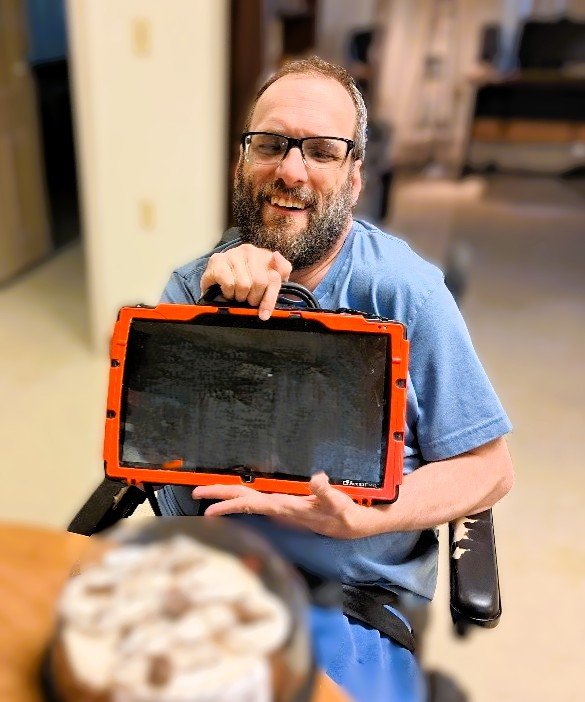
My name is Kyle Glozier (he/him), and I’ve been using PRC‑Saltillo products since I was four years old. My AAC journey began with the Touch Talker — one of the earliest speech‑generating devices PRC ever made — paired with the Interaction, Education, and Play Minspeak program in Kenosha County’s Physically Handicapped/Other Health Impairment classroom. That device didn’t just give me access to communication; it opened the door to the rest of my life.
In 1993, when I was seven, I attended Talking with Technology Camp at the Easterseals Rocky Mountain Village in Empire, Colorado. I went every summer from 1993 through 1997, and those years shaped me in ways I’m still grateful for. The camp wasn’t just about learning how to use a communication device — it was about learning how to communicate confidently, how to connect with other AAC users, and how to grow up with a voice that looked different from everyone else’s but mattered just as much.
In 1998, I received my Liberator and switched to Unity. That device became a major turning point in my communication. It wasn’t just a new AAC system — it was the tool that helped me step into advocacy on a national level. I used my Liberator when I represented ADAPT at the Democratic National Convention. Sitting there with my AAC device, speaking for a national disability rights organization, taught me something important: AAC isn’t just about having a voice. It’s about being heard in places where disabled voices are too often ignored because they are too often not understood. That moment proved that communication access can open doors all the way to the national stage.
Since 2000, I’ve used my voice — whether it was my Liberator, my Pathfinder, my ECO, or my Accent — to advocate for disability rights and LGBTQ rights. Each device became part of my identity, part of the way I showed up in the world, and part of how I made sure my voice was heard in spaces where disabled voices are often overlooked. In 2003, I attended the two‑week Augmentative Communication Employment Services program run by Temple University’s Institute on Disabilities, further strengthening my commitment to AAC advocacy and employment access.
AAC has never been “just a tool” for me. It has been the bridge that let me participate, organize, speak out, and stand alongside other advocates. No matter which device I was using at the time, it gave me access to the same conversations, the same movements, and the same fights for equality as anyone else.
Becoming a PRC‑Saltillo Ambassador feels like a natural next step in my AAC journey. It’s an honor to represent the company whose devices have supported my voice since childhood, and I’m excited to share what AAC has made possible in my life.